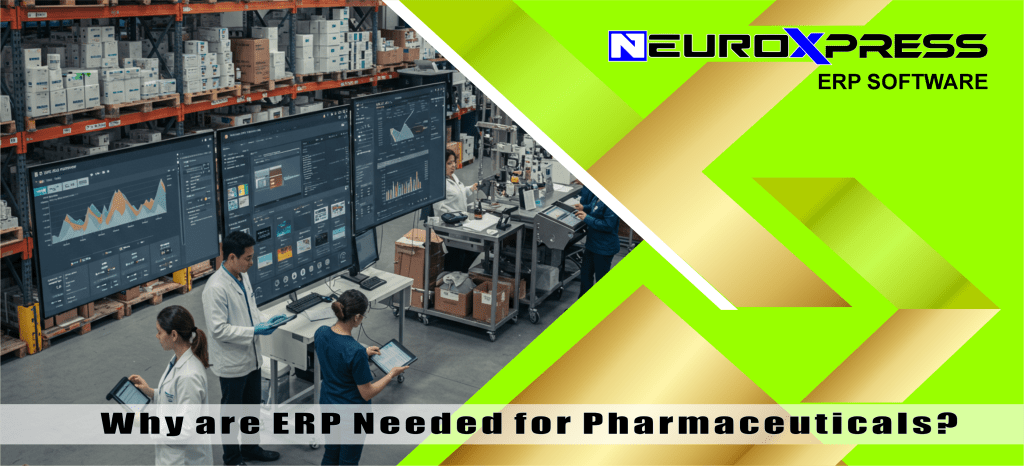
Why are ERP Needed for Pharmaceuticals? The pharmaceutical industry operates under a unique and exceptionally stringent set of demands. From the rigorous process of drug discovery and development to highly regulated manufacturing, complex global supply chains, and strict compliance mandates, every step is critical and carries significant implications for public health.
Managing these multifaceted operations with disparate systems or manual processes isn’t just inefficient; it’s a direct threat to product quality, patient safety, and regulatory adherence.
This pressing need for precision, traceability, and control leads to a fundamental question for companies in this sector: Why are ERP needed for Pharmaceuticals? This article explores the compelling reasons why an Enterprise Resource Planning (ERP) system is not merely beneficial, but an absolute necessity for pharmaceutical companies striving for operational excellence, innovation, and unwavering compliance.
Imagine “BioGenesis Pharma,” a mid-sized pharmaceutical company developing a groundbreaking new oncology drug. Their R&D department generated mountains of data, the manufacturing plant faced intense pressure to ensure batch consistency, and their distribution network spanned multiple continents, each with its own regulations. The CEO, Dr. Anya Sharma, was constantly worried about disconnected data.
Could they trace every raw material in a specific drug batch if there was a recall? Was their clinical trial data securely managed and audit-ready? Were they truly optimizing their manufacturing schedule to meet demand while maintaining stringent quality checks?
Without a unified system, these questions created immense risk and slowed down their progress. Dr. Sharma’s concerns perfectly encapsulate why are ERP needed for Pharmaceuticals today.
The Pharmaceutical Industry’s Unique Operational Landscape
The pharmaceutical sector is unlike almost any other industry. It is characterized by several critical complexities that demand sophisticated management tools:
- Stringent Regulatory Compliance: Governed by bodies like the FDA (U.S.), EMA (Europe), and others globally, pharmaceutical companies must adhere to GxP (Good Manufacturing Practices, Good Laboratory Practices, Good Clinical Practices), 21 CFR Part 11 (for electronic records and signatures), and serialization mandates (e.g., DSCSA in the U.S.). Non-compliance can result in massive fines, product recalls, and even criminal charges.
- Complex R&D and Clinical Trials: The drug development lifecycle is lengthy, resource-intensive, and generates vast amounts of sensitive data that must be meticulously managed and secured.
- Batch Manufacturing and Traceability: Production involves precise batch formulations, strict quality control at every stage, and the absolute necessity for end-to-end traceability of every ingredient and finished product.
- Global Supply Chains: Sourcing raw materials globally and distributing finished products worldwide adds layers of complexity, risk, and regulatory challenges.
- Inventory Management of Controlled Substances and Expiry Dates: Handling highly regulated raw materials, finished goods, and products with strict expiration dates requires precise inventory control and segregation.
- Intellectual Property (IP) Protection: Sensitive formulas, research data, and proprietary processes must be protected with robust security measures.
Attempting to manage these complexities with manual processes or disparate systems is a recipe for errors, inefficiencies, and catastrophic compliance failures.
Core Areas Where ERP Helps in Pharmaceuticals
An ERP system addresses the unique pain points of the pharmaceutical industry by integrating critical functions into a single, cohesive platform. This unified approach provides the answers to why are ERP needed for Pharmaceuticals.
1. Enhanced Regulatory Compliance and Quality Management
This is arguably the most vital role of ERP in pharma.
- GxP Adherence: ERP systems designed for pharma incorporate features to enforce GxP guidelines throughout manufacturing, quality control, and documentation.
- Audit Trails & Electronic Signatures (21 CFR Part 11): Provides detailed, unalterable audit trails for every system activity, linked to electronic signatures, ensuring data integrity and accountability required by regulations.
- Batch Traceability & Serialization: Enables end-to-end (bi-directional) traceability from raw material receipt through production to final distribution. This includes serialization for individual product units, crucial for anti-counterfeiting and efficient recalls.
- Document Management: Centralizes and automates documentation processes, ensuring version control, approval workflows, and easy access for audits.
- Quality Control (QC) Integration: Manages inbound material QC, in-process QC, and finished product testing, ensuring products meet predefined specifications. This includes non-conformance management and corrective and preventive actions (CAPA).
2. Streamlined Manufacturing and Production
Pharmaceutical manufacturing requires precision and control. ERP streamlines these processes:
- Formula & Recipe Management: Securely stores and manages complex formulations, Bill of Materials (BOMs), and routings with version control.
- Batch Production Management: Automates batch order creation, scheduling, and execution, reducing manual errors and improving throughput.
- Yield & Waste Management: Tracks material consumption and yield at each production stage, helping minimize waste and optimize resource utilization.
- Equipment Management: Schedules and tracks equipment maintenance, calibration, and validation to ensure operational readiness and compliance.
3. Efficient Supply Chain and Inventory Management
The pharmaceutical supply chain is complex and critical.
- Real-time Inventory Visibility: Provides precise tracking of raw materials, work-in-progress, and finished goods, including real-time stock levels, locations, and expiry dates.
- Expiry Date & Lot Management: Crucial for managing perishable and short-dated drugs, minimizing waste and ensuring only viable products are used and distributed.
- Demand Forecasting & Procurement: Uses historical data and sales forecasts to optimize purchasing, ensuring timely raw material availability and preventing stock-outs or overstocking.
- Vendor Management: Streamlines procurement processes and supplier relationship management, ensuring quality and compliant sourcing.
4. Financial Management and Cost Control
ERP centralizes financial operations, providing clarity and control.
- Integrated Accounting: Manages General Ledger, Accounts Payable, Accounts Receivable, and fixed assets across all departments, providing a unified financial view.
- Product Costing: Accurately calculates product costs, factoring in raw materials, labor, overhead, and quality control expenses, essential for pricing and profitability analysis.
- Budgeting & Forecasting: Supports robust financial planning, budgeting, and forecasting, crucial for R&D investments and operational sustainability.
5. Research & Development (R&D) Integration
While not always a primary focus, some ERPs offer or integrate with R&D modules to:
- Project Management: Track R&D project timelines, budgets, and resource allocation.
- Data Management: Securely store and manage research data, formulations, and intellectual property.
Here’s a table summarizing how ERP helps the pharmaceutical industry:
Why are ERP Needed for Pharmaceuticals? The Overarching Benefits
Beyond the specific departmental advantages, ERP systems deliver overarching strategic benefits that are particularly critical for the pharmaceutical sector.
1. Risk Mitigation and Compliance Assurance
The pharmaceutical industry operates in a high-risk, high-regulation environment. An ERP system acts as a centralized compliance hub, automating controls, enforcing procedures, and providing audit-ready documentation. This significantly reduces the risk of human error, data inconsistencies, and regulatory penalties.
2. Improved Operational Efficiency and Cost Reduction
By integrating disparate processes and automating manual tasks, ERP streamlines operations from drug discovery to distribution. This leads to reduced lead times, optimized resource utilization, minimized waste, and ultimately, lower operational costs. For instance, automated inventory management reduces carrying costs associated with expired drugs or excess stock.
3. Enhanced Data Accuracy and Real-time Visibility
A single source of truth ensures that all departments are working with the same, accurate data. This real-time visibility into production, inventory, sales, and financials enables faster, more informed decision-making, crucial for responding to market demands or unexpected challenges.
4. Faster Time-to-Market for New Drugs
By optimizing R&D project management, streamlining manufacturing processes, and ensuring compliance from early stages, ERP can help pharmaceutical companies accelerate the development and launch of new drugs, gaining a critical competitive advantage.
5. Scalability for Growth and Innovation
A robust ERP system provides a scalable platform that can accommodate increasing transaction volumes, new product lines, global expansion, and even mergers and acquisitions. It ensures that the underlying technology infrastructure can support future growth without hindering innovation.
Dr. Anya Sharma at “BioGenesis Pharma” eventually implemented a specialized ERP solution. The transformation was profound. Her R&D team could now securely log and track every experiment, linking it directly to project costs.
In manufacturing, every raw material batch was meticulously tracked from arrival to final product, ensuring complete traceability. If a batch deviation occurred, the ERP’s audit trails and quality modules allowed for rapid investigation and corrective action, significantly reducing compliance risk.
The global distribution module streamlined logistics, adapting to varied regional regulations. Dr. Sharma finally had the real-time insights she needed, allowing her to focus on innovation and market expansion, knowing that BioGenesis Pharma’s operations were compliant, efficient, and resilient. This demonstrates precisely why are ERP needed for Pharmaceuticals.
Challenges in Implementing ERP for Pharmaceuticals
- High Cost and Complexity: Specialized pharmaceutical ERPs are a significant investment due to their intricate features and validation requirements.
- Validation Requirements: The system itself, and sometimes its implementation processes, must be validated to ensure compliance with GxP and 21 CFR Part 11, which is a time-consuming and resource-intensive endeavor.
- Data Migration: Transferring vast amounts of sensitive and highly regulated data from legacy systems can be complex and risky.
- Specific Industry Knowledge: The ERP vendor or implementation partner must possess deep expertise in pharmaceutical regulations and processes.
Here’s a Pros & Cons table summarizing ERP in Pharma:
Conclusion: Why are ERP Needed for Pharmaceuticals?
In conclusion, finds its answer in the unparalleled ability of these integrated systems to address the industry’s most critical and complex demands. An ERP is not merely a tool for efficiency; it is a foundational pillar for ensuring patient safety, maintaining product quality, and navigating the labyrinthine world of regulatory compliance.
From meticulous batch traceability and stringent quality control to optimized global supply chains and robust financial oversight, ERP systems provide the digital backbone that enables pharmaceutical companies to operate with precision, transparency, and accountability.
While the implementation journey can be challenging, the necessity for a unified, compliant, and intelligent platform far outweighs the risks of continuing with fragmented or manual processes. For pharmaceutical companies, an ERP system is the indispensable investment that drives innovation, ensures integrity, and secures their place in a highly regulated and rapidly evolving global market.