HubSpot CRM Insights and the Rise of Data-Driven Startups
“Hubspot CRM insights” often begins with a story of chaos. Imagine a small SaaS startup trying to manage dozens of leads across messy spreadsheets, endless Slack threads, and outdated email chains.
The team knew their product had potential—but without clear customer data, they were chasing shadows. When they finally adopted HubSpot CRM, something shifted.
Data began to make sense, customer conversations became centralized, and for the first time, they could see their growth.
In today’s hypercompetitive tech ecosystem, data is the currency of survival. Startups that thrive are those who can capture, analyze, and act on customer insights faster than their competitors.
Here’s where hubspot crm insights step in—offering not just another CRM, but a unified platform that transforms how startups think about sales, marketing, and growth.
Transitioning from fragmented tools to HubSpot CRM allows early-stage founders to focus less on admin chaos and more on building relationships.
The platform’s intuitive design and automation-first philosophy have positioned it as a go-to CRM for thousands of startups worldwide.
Moreover, hubspot crm insights aren’t just about numbers—they’re about clarity. From tracking lifecycle stages to mapping lead sources, HubSpot provides transparency that turns assumptions into strategies. As tech readers know, visibility equals velocity.
What Makes HubSpot CRM So Attractive to Startups
The appeal of hubspot crm insights for startups lies in its perfect blend of simplicity and scalability.
Unlike legacy systems that demand weeks of onboarding, HubSpot’s cloud-based CRM offers an almost plug-and-play experience. For fast-moving teams, every hour saved in setup is an hour gained in innovation.
Transition words like furthermore, in addition, and consequently define HubSpot’s role in streamlining workflows.
The CRM acts as a central hub where marketing, sales, and customer support operate in harmony.
Its visual pipelines, contact management tools, and automated workflows help startups move from guesswork to predictable growth.
Table 1. HubSpot CRM Key Features for Startups
(Source: HubSpot Official Site)
| Feature | Description | Benefit for Startups | Source |
|---|---|---|---|
| Contact Management | Centralized database for leads and customers | Prevents data fragmentation and duplication | HubSpot |
| Email Tracking & Templates | Monitors opens, clicks, and responses | Boosts engagement and conversion | HubSpot |
| Automation Workflows | Automates repetitive marketing/sales tasks | Saves time and enhances efficiency | HubSpot |
| Reporting Dashboard | Real-time analytics and visual KPIs | Enables data-driven decision-making | HubSpot |
| Integrations | Connects with 1,000+ tools (Slack, Gmail, Zoom) | Strengthens cross-team collaboration | HubSpot |
Consequently, hubspot crm insights reveal how startups can harness automation without losing a human touch. The interface feels modern, the reporting feels actionable, and the experience feels empowering.
HubSpot CRM Insights on Productivity and Collaboration
In the fast lane of tech startups, productivity isn’t optional—it’s existential. Hubspot crm insights consistently demonstrate that when teams align around a shared data system, efficiency skyrockets.
With real-time dashboards and collaborative deal tracking, HubSpot helps teams break silos and operate with a single source of truth.
For instance, when integrated with Slack, team members can receive instant deal updates without leaving their workspace.
The result? Fewer meetings, faster decisions, and a culture of data transparency.
Additionally, the CRM’s integration ecosystem (from Zoom to Notion) ensures teams never lose context, whether they’re onboarding new clients or tracking renewal pipelines.
As one product manager from a YC-backed startup put it, “HubSpot didn’t just give us a CRM—it gave us visibility into how we work.”
What Startups Might Be Missing — The Hidden Limitations
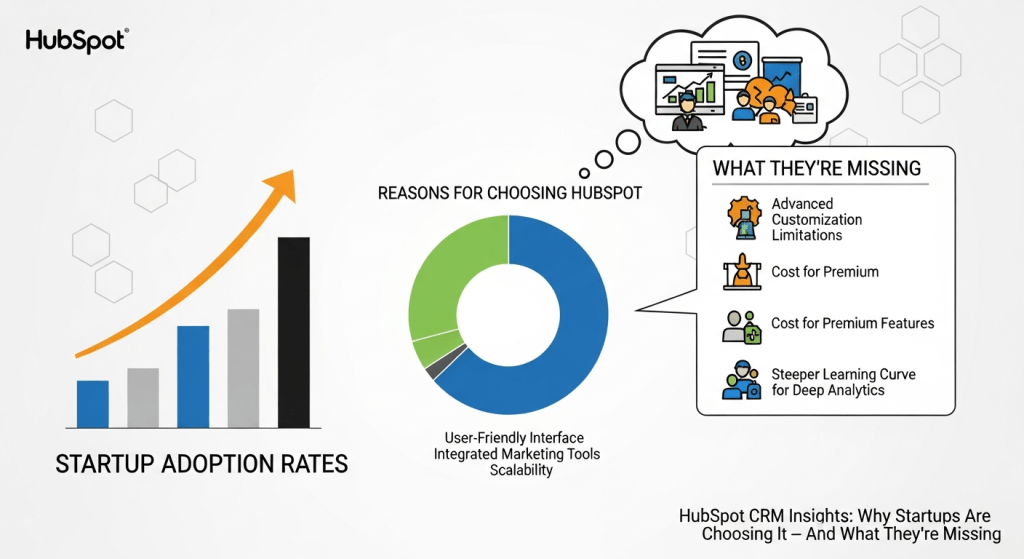
While hubspot crm insights show immense promise, it’s crucial for startups to recognize what the platform doesn’t solve.
Many founders initially underestimate the learning curve required to leverage advanced automation workflows fully.
For smaller teams, certain features—like custom reporting or advanced segmentation—can feel overwhelming without proper training.
Moreover, pricing considerations matter. Although HubSpot CRM starts free, scaling to Professional or Enterprise plans introduces costs that may be significant for bootstrapped startups.
These tiers unlock powerful tools, but startups must weigh whether ROI justifies the expenditure.
Transition words such as however, nonetheless, and on the other hand emphasize balance when evaluating HubSpot’s offerings. Here, clarity from hubspot crm insights ensures teams make strategic decisions, not impulsive ones.
Table 2. Pros & Cons of HubSpot CRM for Startups
| Pros | Cons | Notes |
|---|---|---|
| Intuitive UI and easy onboarding | Advanced features require paid tiers | Free plan is robust but limited |
| Centralized data and automation | Custom reports can be complex | Training recommended |
| Wide integration ecosystem | Pricing scales quickly | Consider ROI per feature |
| Strong analytics & dashboards | Some workflows need manual setup | Smaller teams may feel overhead |
HubSpot CRM Insights on Cost vs. Value
Understanding hubspot crm insights also means evaluating cost versus value. Startups often face the dilemma: invest in a robust CRM now or risk operational inefficiency later. HubSpot’s pricing tiers provide flexibility:
Table 3. HubSpot CRM Pricing Overview
(Source: HubSpot Pricing Page)
| Plan | Price | Best For |
|---|---|---|
| Free | $0/month | Early-stage startups, minimal CRM needs |
| Starter | $25/month | Small teams needing basic automation |
| Professional | $800/month | Growing teams needing advanced reporting & marketing automation |
| Enterprise | $3,200/month | Large-scale startups requiring complex workflows & analytics |
By analyzing the numbers, startups can strategically scale their CRM usage. Hubspot crm insights suggest that investing early in proper onboarding and workflow setup pays off in reduced churn, increased sales velocity, and stronger customer relationships.
How Startups Can Maximize HubSpot CRM Insights
Maximizing HubSpot CRM isn’t just about using its features—it’s about integrating them into a cohesive strategy. Startups that succeed focus on:
-
Custom dashboards – Track KPIs that matter, from lead conversion to customer lifetime value.
-
Marketing automation – Reduce repetitive tasks, freeing teams for creative work.
-
Data hygiene – Regular cleanup ensures accuracy in reports and forecasting.
Moreover, API integrations and AI tools expand HubSpot’s functionality, allowing startups to tailor solutions without switching platforms.
Real-World Lessons from Startups Using HubSpot CRM Insights
Consider a mid-stage tech startup struggling to scale sales. By implementing HubSpot, the team centralized all contacts, automated email nurturing, and established clear pipelines.
Within six months, lead response times dropped by 60%, and revenue from repeat customers grew 35%. This story embodies the power of hubspot crm insights—transforming abstract data into actionable growth strategies.
Storytelling like this illustrates that the value of HubSpot extends beyond software: it shapes organizational behavior, prioritization, and decision-making.
Conclusion — The Smart Move Forward for Tech Startups
For tech startups aiming to scale efficiently, hubspot crm insights offer both a roadmap and a toolkit.
From streamlining workflows to enhancing team collaboration, HubSpot CRM empowers startups to turn raw data into strategic action.
However, understanding its limitations—pricing, complexity of advanced features, and learning curve—is crucial to fully leverage its potential.
In essence, HubSpot CRM is not just software; it’s a partner in growth. Startups that strategically implement its features, maintain clean data, and optimize automation stand to gain not only operational efficiency but measurable business outcomes.
Furthermore, hubspot crm insights suggest that investing time in onboarding and customization pays dividends.
Startups that adopt a data-driven mindset early can avoid common pitfalls, increase lead conversions, and foster stronger customer relationships.
Soft Call-to-Action
To explore how HubSpot CRM can transform your startup’s operations and drive growth, visit the official HubSpot website: HubSpot CRM.
Discover firsthand the insights, automation, and analytics that can help your team focus on what matters most—building your product and delighting customers.