Introduction to Enterprise Infrastructure Decision
Server vs Cloud Hosting is no longer a purely technical debate inside enterprise IT rooms. Instead, it has become a strategic conversation at the executive level.
A CIO reviewing quarterly reports may notice that infrastructure costs are rising faster than revenue, even though workloads appear stable.
Meanwhile, application teams demand higher performance, stronger security, and faster deployment cycles.
At this point, infrastructure decisions directly influence business outcomes. Choosing the wrong model can silently erode return on investment, while the right choice can unlock long-term efficiency.
Therefore, enterprises increasingly evaluate hosting options not only based on specifications, but also on financial predictability and operational control.
Moreover, enterprise workloads are rarely simple. They involve mission-critical databases, compliance-sensitive data, and performance-intensive applications.
As a result, infrastructure selection becomes a balancing act between cost optimization and business continuity.
Server vs Cloud Hosting in Modern Enterprise IT Strategy
Enterprise IT strategies have evolved significantly over the past decade. In the past, organizations relied heavily on on-premise systems with fixed capacity planning.
Although this approach offered control, it often led to underutilized resources and high capital expenditure.
Over time, dedicated servers emerged as a middle ground. They provided isolated hardware, predictable performance, and clearer cost structures.
Consequently, many enterprises adopted dedicated environments for core workloads that required stability rather than elasticity.
Cloud hosting later disrupted this model by introducing on-demand scalability and rapid provisioning. However, while flexibility increased, cost transparency sometimes decreased.
Enterprises began to realize that elasticity, although powerful, must be managed carefully to avoid unexpected spending.
Therefore, modern IT strategies now focus on aligning infrastructure models with workload behavior rather than following trends blindly.
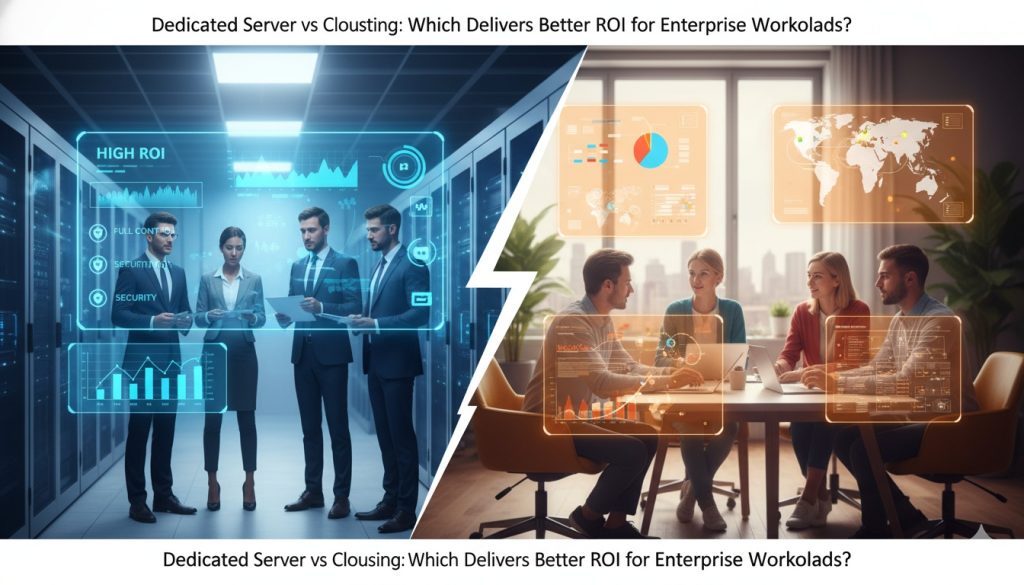
How Enterprises Evaluate ROI Between Dedicated Servers and Cloud Platforms
When enterprises evaluate infrastructure ROI, they rarely focus on monthly invoices alone. Instead, they assess long-term efficiency, operational overhead, and risk exposure.
This evaluation process often involves both technical leaders and financial stakeholders.
In many cases, teams start by analyzing workload patterns. Stable, predictable applications are examined differently from dynamic or seasonal workloads. As a result, ROI calculations become contextual rather than universal.
Midway through this evaluation, the discussion around Server vs Cloud Hosting usually shifts from “which is cheaper” to “which aligns better with business priorities.” This mindset change allows enterprises to assess value beyond surface-level pricing.
Server vs Cloud Hosting for Performance-Critical Workloads
Performance remains a top priority for enterprise workloads such as transactional systems, analytics platforms, and customer-facing applications.
Dedicated servers often deliver consistent performance because resources are not shared. Consequently, latency-sensitive workloads benefit from predictable hardware behavior.
Cloud platforms, on the other hand, provide scalability but may introduce performance variability depending on configuration.
Although modern cloud providers offer high-performance options, enterprises must actively manage instance types and architectures. Therefore, performance ROI depends heavily on governance rather than raw capability.
Server vs Cloud Hosting from a Cost Predictability Perspective
Cost predictability plays a major role in enterprise budgeting. Dedicated servers typically follow fixed pricing models, which simplifies forecasting. As a result, finance teams appreciate the stability and transparency they provide.
Cloud hosting adopts a pay-as-you-go approach. While this model supports agility, costs can grow unexpectedly when workloads scale without proper controls.
Consequently, enterprises must invest in monitoring and optimization tools to maintain financial discipline. In this context, ROI is influenced as much by management maturity as by infrastructure choice.
Key Differences That Impact Enterprise ROI
Understanding the structural differences between infrastructure models helps enterprises quantify ROI more accurately. Each approach introduces unique advantages and trade-offs that influence long-term value.
Dedicated Server vs Cloud Hosting Comparison
| Criteria | Dedicated Server | Cloud Hosting | ROI Impact |
|---|---|---|---|
| Cost Structure | Fixed monthly pricing | Variable, usage-based | Predictability vs flexibility |
| Performance | Consistent and isolated | Scalable but variable | Stability vs elasticity |
| Scalability | Manual or planned | On-demand | Planning vs responsiveness |
| Operational Control | Full hardware control | Shared responsibility | Governance requirements |
Data source: Public information from enterprise hosting providers such as AWS, Microsoft Azure, Google Cloud, OVHcloud, and Equinix.
Pros and Cons of Dedicated Servers vs Cloud Hosting
Every enterprise infrastructure decision involves trade-offs. Therefore, evaluating advantages and limitations side by side helps decision-makers align technology with business objectives rather than assumptions.
Pros & Cons Overview
| Dedicated Server | Cloud Hosting |
|---|---|
| Predictable performance and cost | High scalability and flexibility |
| Full hardware isolation | Rapid provisioning and global reach |
| Strong control over security and compliance | Reduced upfront investment |
| Requires capacity planning | Costs may grow without governance |
This comparison highlights that ROI is influenced not only by technology, but also by how well an organization manages its infrastructure model.
Pricing Models and Cost Efficiency for Enterprise Workloads
Pricing structures significantly affect long-term ROI. Dedicated servers typically operate under fixed monthly or annual contracts.
As a result, enterprises gain clear visibility into infrastructure spending, which supports stable financial planning.
Cloud hosting, by contrast, uses consumption-based pricing. While this enables rapid experimentation and scaling, it can complicate cost forecasting.
Consequently, enterprises often invest in cost management tools and FinOps practices to maintain efficiency.
Pricing Model Comparison
| Infrastructure Type | Pricing Model | Best Use Case |
|---|---|---|
| Dedicated Server | Fixed recurring cost | Stable, long-term workloads |
| Cloud Hosting | Pay-as-you-go | Variable or seasonal workloads |
Data source: Pricing frameworks published by major enterprise infrastructure providers including AWS, Microsoft Azure, Google Cloud, and leading dedicated hosting vendors.
Security, Compliance, and Control Considerations
Security and compliance are critical factors for enterprise workloads, especially in regulated industries.
Dedicated servers provide direct control over hardware, network segmentation, and data locality. Therefore, they are often preferred where strict compliance requirements apply.
Cloud platforms follow a shared responsibility model. Although providers secure the underlying infrastructure, enterprises remain responsible for configuration and access control.
As a result, security posture depends heavily on internal governance and expertise.
In both models, ROI can be negatively impacted by security incidents or compliance failures. Consequently, enterprises evaluate infrastructure not only for performance, but also for risk mitigation.
Which Enterprise Scenarios Benefit Most from Each Model
Different workloads demand different infrastructure strategies. Financial services organizations often favor dedicated servers for predictable performance and regulatory alignment.
Meanwhile, SaaS companies may leverage cloud hosting to support rapid growth and geographic expansion.
Data-intensive workloads with consistent usage patterns tend to benefit from fixed-cost environments.
Conversely, innovation-driven teams prefer elastic platforms that support experimentation. In many cases, enterprises adopt a hybrid approach to balance stability and agility.
During these evaluations, the discussion around Server vs Cloud Hosting becomes less about preference and more about strategic fit across the application portfolio.
Final Thoughts: Choosing the Right Infrastructure for Sustainable ROI
Enterprise ROI is rarely determined by infrastructure cost alone. Instead, it emerges from the interaction between performance reliability, operational efficiency, and financial predictability.
Dedicated servers and cloud hosting each offer distinct advantages when aligned correctly with workload characteristics.
Enterprises seeking sustainable ROI should evaluate real usage patterns, compliance needs, and internal management maturity.
Exploring official documentation and consulting enterprise-grade hosting providers can help organizations identify the most effective infrastructure strategy for long-term growth.