Dedicated Server Compliance: Why the Right Choice Matters for Modern Businesses
Dedicated Server Compliance is no longer a technical afterthought—it has become a strategic decision that directly affects business continuity, trust, and long-term growth.
Imagine a fast-growing digital company that suddenly faces a compliance audit after expanding into new markets.
Traffic is increasing, customer data is multiplying, and regulations are tightening. At that moment, infrastructure choices stop being purely technical and start becoming business-critical.
In today’s landscape, companies are expected to protect data, maintain consistent performance, and control costs simultaneously.
However, balancing these expectations is rarely simple. A dedicated server often appears as the most reliable solution, yet choosing the wrong configuration or provider can introduce unnecessary risk rather than stability.
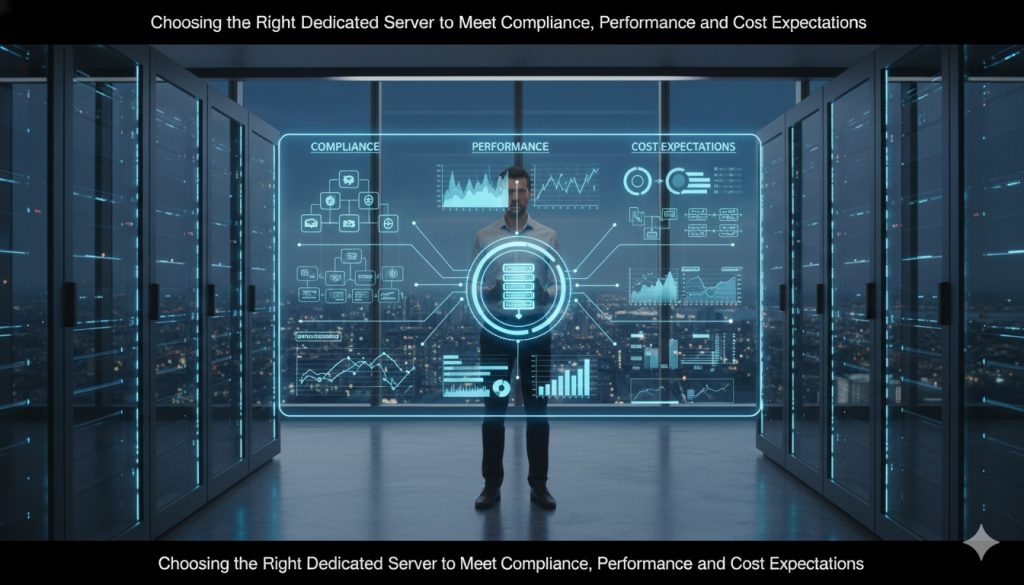
Therefore, understanding how compliance, performance, and budget intersect is essential before making a final decision.
Dedicated Server Compliance and Regulatory Requirements Across Industries
Regulatory pressure varies across industries, but the consequences of non-compliance are consistently severe. From fines to reputational damage, infrastructure plays a central role in whether an organization passes or fails regulatory scrutiny.
Dedicated Server Compliance for Data Protection Standards (GDPR, HIPAA, ISO 27001)
Data protection laws have reshaped how businesses handle sensitive information. Regulations such as GDPR in Europe, HIPAA in healthcare, and ISO 27001 globally require organizations to demonstrate clear control over data access, storage, and processing.
A dedicated server environment helps meet these expectations by offering physical isolation, customizable security policies, and predictable data residency.
For example, healthcare providers managing patient records must ensure that data never leaves approved jurisdictions.
Similarly, SaaS companies operating in multiple regions often need infrastructure flexibility to align with regional compliance requirements.
In these scenarios, dedicated infrastructure offers visibility and control that shared environments simply cannot match.
To support this evaluation, the table below summarizes common compliance frameworks and their typical infrastructure implications.
| Regulation / Standard | Industry Focus | Key Infrastructure Requirement | Source |
|---|---|---|---|
| GDPR | General / EU | Data residency & access control | EU Commission |
| HIPAA | Healthcare | Secure data isolation & logging | HHS.gov |
| ISO 27001 | Cross-industry | Auditable security controls | ISO.org |
Table data compiled from public regulatory documentation and official regulatory bodies.
Dedicated Server Compliance in Financial and E-Commerce Environments
Financial services and e-commerce platforms face an additional layer of scrutiny. Payment data, transaction logs, and customer credentials are all subject to strict oversight.
Standards such as PCI DSS require continuous monitoring, encrypted data handling, and restricted administrative access.
In practice, this means that infrastructure must support advanced logging, intrusion detection, and regular audits.
A dedicated server allows organizations to configure these controls without sharing resources with other tenants.
As a result, businesses gain clearer audit trails and stronger accountability, which simplifies both internal and external compliance assessments.
Midway through one global retailer’s expansion, performance issues triggered unexpected checkout failures during peak sales hours.
While the initial concern was speed, the deeper issue revealed limited visibility into security events.
Migrating to dedicated infrastructure not only stabilized transactions but also improved audit readiness—demonstrating how compliance and performance often intersect.
Performance Expectations When Selecting a Dedicated Server
Compliance alone does not define success. Even the most secure infrastructure fails if it cannot deliver consistent performance under real-world workloads.
Performance expectations should be evaluated with both current demand and future growth in mind.
Hardware Optimization and Resource Allocation
Dedicated servers provide exclusive access to hardware resources, which directly impacts performance predictability.
CPU cores, RAM capacity, and storage type can be tailored to application needs rather than shared among multiple users.
For data-intensive workloads, NVMe storage significantly reduces latency, while high-memory configurations benefit analytics platforms and enterprise applications.
Moreover, resource allocation flexibility allows organizations to optimize costs by avoiding overprovisioning.
Instead of paying for unused capacity, businesses can align hardware specifications with actual workload requirements. Consequently, performance tuning becomes a proactive strategy rather than a reactive fix.
Network Reliability and Latency Considerations
Network performance is equally critical. Bandwidth availability, redundancy, and routing quality determine how users experience applications across regions.
Dedicated servers hosted in Tier-1 data centers typically offer low-latency connectivity and high uptime guarantees, which is especially important for customer-facing platforms.
Consider a media platform experiencing unpredictable traffic spikes during live events. Without guaranteed network throughput, even powerful hardware can underperform.
Dedicated network resources ensure stable delivery, allowing teams to focus on content and growth rather than firefighting outages.
Balancing Performance and Cost Efficiency Without Sacrificing Stability
As businesses scale, infrastructure spending often becomes a sensitive topic. On one hand, performance demands continue to rise.
On the other, finance teams expect predictable and justifiable costs. Finding balance requires more than comparing monthly prices—it demands understanding what is actually included.
Dedicated servers are commonly priced based on hardware specifications, management level, and data center location.
While unmanaged servers may appear cheaper upfront, they often shift operational responsibility to internal teams.
Conversely, managed services include monitoring, patching, and incident response, which can reduce long-term operational strain.
Therefore, cost efficiency should be evaluated over the entire lifecycle of the server, not just the initial invoice.
Cost Structures and Pricing Models Explained
Different providers use different pricing approaches. Some offer fixed monthly rates, while others provide customizable builds with add-on services.
Understanding these models helps decision-makers avoid unexpected expenses.
| Pricing Model | What’s Included | Best For | Pros | Cons | Source |
|---|---|---|---|---|---|
| Fixed Configuration | Predefined hardware & bandwidth | SMEs, predictable workloads | Simple billing | Limited flexibility | Provider pricing pages |
| Custom Build | Tailored CPU, RAM, storage | Growing businesses | Scalable | Requires planning | Vendor documentation |
| Managed Dedicated | Monitoring, updates, support | Enterprise teams | Reduced ops burden | Higher monthly cost | Industry reports |
Table compiled from public pricing pages of global hosting providers and cloud infrastructure reports.
Hidden Costs and Long-Term Scalability Risks
Hidden costs are rarely visible during initial comparison. Downtime, emergency support, and future migrations often carry higher expenses than anticipated.
For example, choosing a provider without clear upgrade paths may force a full infrastructure migration when growth accelerates.
Additionally, lack of transparency around bandwidth limits or overage fees can quickly inflate monthly bills.
By contrast, providers that clearly define resource thresholds and upgrade options offer better long-term predictability.
How to Evaluate Dedicated Server Providers Effectively
Choosing a provider is as important as choosing the server itself. Technical specifications may look identical on paper, yet service quality can vary significantly.
Certifications, Transparency, and Infrastructure Standards
Trustworthy providers publish clear documentation about their data centers, security controls, and operational processes.
Certifications such as ISO standards or SOC reports indicate maturity, but transparency in communication is equally important.
Moreover, data center location matters. Providers with multiple geographic options allow businesses to align infrastructure placement with regulatory and performance needs.
Publicly available resources from organizations like ISO.org and Cloud Security Alliance help buyers understand what these certifications actually represent.
Support, SLA, and Operational Reliability
Support responsiveness directly impacts business continuity. A strong SLA should define uptime guarantees, response times, and escalation paths.
While 99.9% uptime may sound impressive, the fine print determines whether compensation or remediation is actually meaningful.
In practice, teams benefit from providers offering 24/7 human support rather than automated ticket loops. Over time, this reliability translates into fewer disruptions and more confidence in infrastructure planning.
────────────────────────────────────────
Practical Checklist Before Making a Final Decision
Before committing to a provider, a structured checklist can simplify evaluation and reduce bias. This approach also supports internal alignment between technical and non-technical stakeholders.
| Evaluation Area | Key Questions to Ask | Priority Level |
|---|---|---|
| Security | Are audits and logs easily accessible? | High |
| Performance | Can hardware scale without migration? | High |
| Cost | Are all fees clearly documented? | Medium |
| Support | Is support available 24/7 with SLA? | High |
| Scalability | Are upgrades non-disruptive? | Medium |
Checklist structure based on common enterprise IT procurement frameworks.
Using this checklist during vendor discussions ensures that decisions are based on measurable criteria rather than assumptions.
Conclusion: Choosing a Dedicated Server That Grows With Your Business
Selecting the right dedicated server is not about chasing the highest specifications or the lowest price.
Instead, it is about aligning infrastructure with business goals, operational capacity, and future growth.
When compliance, performance, and cost are evaluated together, organizations gain a more resilient foundation.
Ultimately, a well-chosen server environment supports innovation rather than limiting it. For businesses seeking long-term stability, it is worth exploring providers that openly document their infrastructure, pricing, and support commitments.
👉 To learn more about enterprise-grade dedicated server solutions, you can explore the official website of your preferred hosting provider and review their technical documentation, compliance statements, and service guarantees before making a final decision.