

Introduction – From Chaos to Confidence
NetSuite Accounting Guide kicked off when Jane, the Finance Manager of a mid-sized manufacturing firm, woke up at 4 a.m. Her inbox was already flooded with late invoices, loose spreadsheets, and anxious team members.
The month-end close had once again stretched into its second week. Between chasing down missing numbers and reconciling inter-company entries, the team was burnt out, frustrated, and operating in reactive mode.
That’s when Jane decided to upgrade to a new system. Enter the NetSuite Accounting Guide-driven transformation — a change that turned her month-end process from dread to delight.
In this article, you’ll learn how the NetSuite Accounting helps business leaders achieve a faster, cleaner, and more strategic month-end close.
Why Traditional Month-End Close Is Painful
NetSuite Accounting Guide begins with understanding why many companies struggle at the end of the month.
Manual journal entries, disconnected systems, spreadsheets everywhere, and lack of visibility are common culprits.
According to a recent article on the month-end close process, many organisations still take 6.4 business days on average to close their books — despite aiming for much less. NetSuite+3Upflow+3Paystand+3
Here are some of the most frequent pain-points:
- Manual data entry and legacy spreadsheets
- Disparate systems that don’t talk to each other
- Delays in reconciliation and missing documentation
- No real-time visibility into financial data
By recognising these issues, the NetSuite Accounting approach forces you to move from chaotic closing to controlled closing.
Enter the NetSuite Accounting Guide – The Game-Changer
NetSuite Accounting Guide is based on leveraging NetSuite’s Financial Close Management capabilities to standardise, automate, and accelerate the month-end close.
According to NetSuite itself, Financial Close Management helps “automate inefficient manual tasks … reducing reliance on spreadsheets … generating timely and accurate financial statements.” NetSuite
With the NetSuite Accounting mindset, your finance team transitions from being data gatherers to business strategists.
Instead of staying in the trenches of transactions, they can shift into reviewing insights, preparing for audits, and advising leadership.
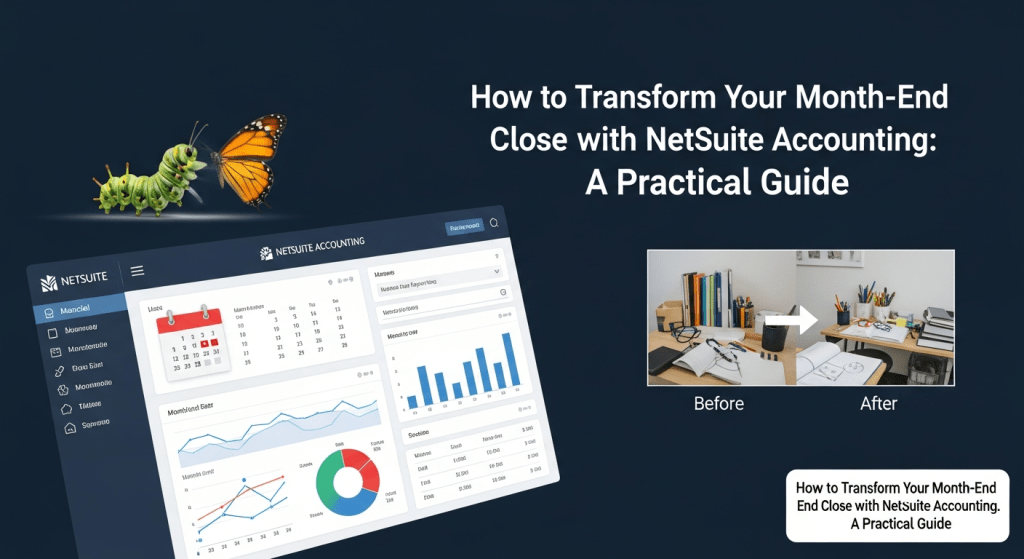
Practical Steps to Transform Your Close Process
Below is a structured checklist that aligns with the NetSuite Accounting Guide theme, combined with best-practice steps you can implement right away.
NetSuite Accounting Guide Step 1 – Automate Journal Entries & Reconciliations
In accordance with the NetSuite Accounting Guide approach, start by automating the most repetitive tasks: journal entries, bank reconciliations, intercompany eliminations.
As NetSuite states, you can automate tasks like reconciliations, transaction matching, and eliminate labour-intensive activities. NetSuite+1
Use Saved Searches and Dashboards (NetSuite Accounting Guide)
With NetSuite Accounting Guide in mind, create saved searches and dashboards for month-end metrics: days sales outstanding, ageing payables, inventory turns, etc. Real-time visibility is a major benefit of automation. NetSuite+1
Standardize Workflow Across Departments (NetSuite Accounting Guide)
Standardisation is key in the NetSuite Accounting Guide framework. Use checklists, roles & responsibilities, approval flows, and payment workflows to avoid last-minute chaos.
For a real-world example, a blog on NetSuite month-end close shows how a checklist helps maintain control and accuracy. Paystand
Implement Locking & Controls (NetSuite Accounting Guide)
One of the more subtle but powerful parts of the NetSuite Accounting is enforcing period-end locks and controls.
Using GL transaction locking maintains integrity, prevents late entries, and supports audit trails. Netgain
NetSuite Accounting Guide Step 2 – Leverage Real-Time Dashboards & Insights
With the NetSuite Accounting Guide in focus, you should shift from “closing the books” to “closing knowledge gaps”.
Dashboards give leadership immediate access to performance, cash flow, and risk indicators — rather than waiting days for manual reports.
NetSuite Accounting Guide Step 3 – Use Standardised Checklists & Close Calendars
According to the NetSuite Accounting philosophy, you should document the closing process: when tasks happen, who approves, what dependencies exist.
A standardized checklist is part of that. For example, one blog shows using a month-end close checklist in NetSuite resulted in better control and faster cycle time. Paystand
Post-Close Review & Continuous Improvement (NetSuite Accounting Guide)
After each close, use the NetSuite Accounting method to conduct a “stop-and-learn” session:
What parts of the process worked smoothly?
Which actions or steps delivered the best results?
What should we continue doing next time?
Where did we see the most success?
Continuous improvement is part of the journey.
Table: NetSuite Financial Close Features and Comparison
Here is a table summarising key features, pros & cons, and approximate pricing ideas (derived from publicly available vendor statements).
Note that actual pricing varies by company size, module usage, and users.
| Feature | Pros | Cons | Notes / Pricing* |
| Period Close Checklist | Ensures sequence & accountability | Requires process discipline | Included in NetSuite Financial Close Management module. NetSuite |
| Bank Reconciliation / Transaction Matching | Automates matching, faster close | May need initial setup/integration | Built-in; implementation cost varies. |
| Financial Consolidation (multi-entity) | Supports global ops & subsidiaries | Complexity grows with group size | Part of NetSuite ERP: “subscribe to NetSuite platform license + modules” NetSuite |
| Exception Detection / AI Monitoring | Flags anomalies early | May need data-maturity to use fully | As per NetSuite: “Exception Detection” feature. NetSuite |
*Pricing is vendor-specific; NetSuite states: “Users subscribe to NetSuite for an annual license fee… core platform + optional modules + number of users”. NetSuite
Real-World Example / Story in Middle
Midway through our NetSuite Accounting Guide journey, let’s revisit Jane’s story.
After implementing the first phase of the NetSuite Accounting— automating journal entries and launching standardised dashboards — Jane’s team reduced their month-end close from 8 days to 4 days.
They used the time they saved to build scenario forecasting, rather than staying buried in spreadsheets.
The team then began to use the NetSuite Accounting checklist across departments:
Sales validated commissions earlier, Inventory reconciled weekly, AP matched invoices daily.
They locked the period with confidence using GL locking controls. As a result, leadership received accurate financial reports two days earlier than before, enabling sharper decisions in the boardroom.
Common Pitfalls & How to Avoid Them (NetSuite Accounting Guide)
When you apply the NetSuite Accounting principles, be aware of common failures:
- Trying to change everything at once: Overhaul of systems + process + training often backfires. Instead, start with quick wins (e.g., automate one reconciliation).
- Ignoring data quality: Automation amplifies garbage in → garbage out. Make sure transactions are accurate and sub-ledgers reconciled.
- Lack of ownership: Without clear roles, tasks slip. The NetSuite Accounting method emphasises who prepares, who reviews, who approves.
- Skipping post-close review: If you never reflect, you never improve. Use the NetSuite Accounting Guide’s continuous improvement loop.
Benefits of Following the NetSuite Accounting Guide
By implementing the NetSuite Accounting approach, companies enjoy benefits such as:
- Faster close cycles — e.g., one study showed close time reduced by 40 % using NetSuite optimization strategies. Stockton10
- Increased accuracy & decreased risk — automation cuts errors significantly. AccountsIQ+1
- Better visibility and strategic insight, enabling leadership to act timely and confidently.
- Improved staff satisfaction and retention — finance teams spend less time firefighting and more time adding value.
Preparing for Implementation – What to Do Next (NetSuite Accounting Guide)
Here’s a roadmap aligned with the NetSuite Accounting:
- Baseline your current process: How many days does your close take? What tasks cause delays?
- Prioritize pain-points: Choose the top 1–2 tasks to automate first (e.g., bank reconciliation, journal entry workflow).
- Define roles & workflows: Assign task owners, reviewers, set deadlines—document in your checklist.
- Configure NetSuite (or your system) accordingly: Use built-in features like period close checklist, reconciliation modules, dashboards.
- Train your team: Even the best tech fails without adoption. Ensure finance staff understand new workflows and automation.
- Monitor & iterate: After each close, review what worked/didn’t — adjust your NetSuite Accounting process accordingly.
Conclusion – From Chaos to Clarity with the NetSuite Accounting Guide
If your month-end close still feels like a sprint, long nights, and messy spreadsheets, the NetSuite Accounting Guide is your roadmap to transformation.
By leveraging automation, standardisation, real-time dashboards, and continuous improvement, you can turn the books-closing ritual into a strategic checkpoint.
Rather than seeing 7-10 days of chaos, your finance team may close in 2-4 days, free up time for value-added work, and provide leadership with insights when it matters most.
Ready to take the next step? Visit the official page of NetSuite Financial Close Management here: NetSuite Financial Close Management and start your journey toward a smarter, faster, and more confident month-end close.


