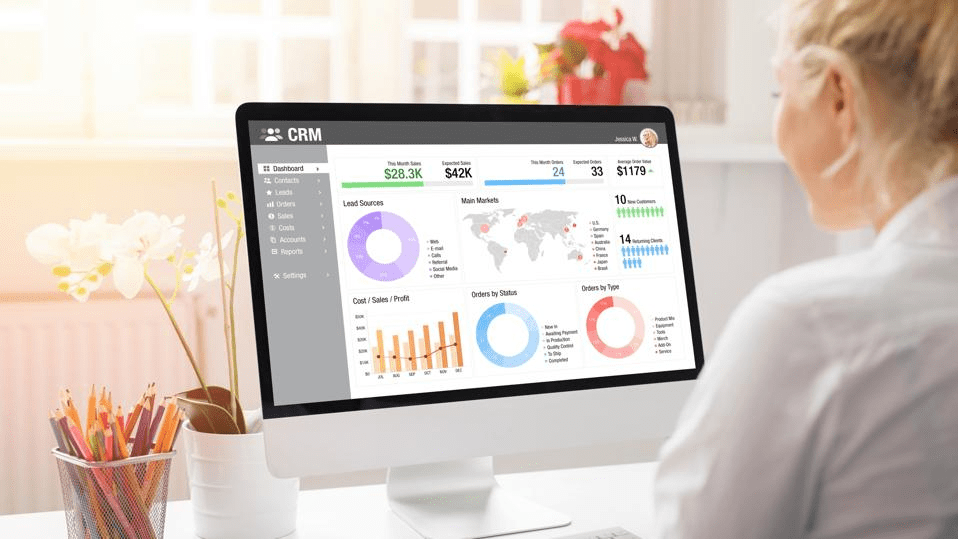
Running a small business without a Customer Relationship Management (CRM) system can feel like juggling too many balls at once. Imagine a bakery owner trying to track customer orders, loyalty rewards, and marketing campaigns manually—it’s overwhelming. But with the right CRM software, managing customers becomes effortless, allowing businesses to focus on growth and customer satisfaction. In this article, we’ll explore the top CRM solutions for small businesses in 2025 and how they can enhance customer relationships.
Why Small Businesses Need a CRM
A CRM system helps businesses by:
- Centralizing customer data: No more spreadsheets—everything is stored in one place.
- Automating follow-ups: Never miss an opportunity to engage customers.
- Improving sales processes: Track leads, sales, and performance metrics.
- Enhancing customer experience: Personalized communication builds loyalty.
Top CRM Software for Small Businesses
| CRM Software | Best For | Key Features | Pricing |
|---|---|---|---|
| HubSpot CRM | Free CRM with essential tools | Contact management, email tracking, sales pipeline | Free, paid plans start at $45/month |
| Salesforce Essentials | Scalable CRM for growing businesses | AI-driven insights, customizable dashboards | Starts at $25/user/month |
| Zoho CRM | Affordable and feature-rich | Sales automation, reporting, integration with other Zoho apps | Starts at $14/user/month |
| Pipedrive | Best for sales-focused teams | Visual sales pipeline, deal tracking | Starts at $12.50/user/month |
| Freshsales | AI-powered automation | Lead scoring, email tracking, reporting | Starts at $15/user/month |
Detailed Breakdown of Each CRM
1. HubSpot CRM – Best Free CRM
HubSpot CRM is ideal for startups and small businesses looking for an easy-to-use solution.
- Pros: Free forever plan, intuitive interface.
- Cons: Advanced features require paid plans.
- Best for: Businesses new to CRM software.
2. Salesforce Essentials – Best for Scaling Businesses
Salesforce is a market leader offering a powerful, scalable CRM.
- Pros: AI-powered insights, customizable workflows.
- Cons: Slight learning curve, higher cost.
- Best for: Businesses planning for rapid growth.
3. Zoho CRM – Best Budget Option
Zoho CRM offers affordability without sacrificing essential features.
- Pros: Cost-effective, integrates with other Zoho apps.
- Cons: Interface can feel outdated.
- Best for: Cost-conscious businesses.
4. Pipedrive – Best for Sales-Driven Teams
Pipedrive is designed for teams focused on closing deals efficiently.
- Pros: User-friendly sales pipeline, strong automation.
- Cons: Limited customization options.
- Best for: Sales teams that need a visual workflow.
5. Freshsales – Best AI-Powered CRM
Freshsales leverages AI to automate sales tasks and improve efficiency.
- Pros: AI-driven lead scoring, strong automation tools.
- Cons: Fewer third-party integrations.
- Best for: Businesses wanting automation-driven sales processes.
Choosing the Right CRM for Your Business
When selecting a CRM, consider:
- Budget: Start with free or affordable options if on a tight budget.
- Ease of Use: A user-friendly interface minimizes training time.
- Scalability: Choose a CRM that can grow with your business.
- Integration: Ensure compatibility with your existing software.
Future Trends in CRM Software
- AI-Powered Automation: More CRM tools will use AI for predictive analytics.
- Mobile Optimization: CRM systems will enhance mobile functionality.
- Personalization Features: Deeper customer insights will improve engagement.
Conclusion
A reliable CRM system is a game-changer for small businesses, providing better organization, automation, and customer insights. Whether you choose HubSpot for its free features or Salesforce for its scalability, investing in the right CRM will set your business up for long-term success in 2025 and beyond.